Nanoscale Learning Note 002
Why Tiny Machines Cannot Coast
Low Reynolds number motion reveals a world where viscosity dominates inertia and familiar movement strategies stop working.
A Different Experience Of Fluid
A person moving through water can push, glide, and rely on momentum. A microscopic object in fluid often experiences something far stranger: motion stops almost as soon as the driving force stops. At that scale, the fluid can behave less like a place to coast and more like a resistance that is always present.
Reynolds number helps organize this change. It compares inertial effects with viscous effects through fluid density, velocity, a characteristic length, and viscosity. When the characteristic length becomes very small, Reynolds number often becomes very small too; viscosity dominates the story.
Why Familiar Propulsion Fails
At low Reynolds number, simply performing a motion and reversing it tends to undo the progress. A symmetric back and forth stroke does not gain the advantage that inertia provides to a swimmer at larger scale. Effective propulsion usually requires a nonreciprocal cycle, a flexible structure, a rotating helix, an external field, a chemical gradient, or another mechanism that breaks the symmetry.
This is a powerful warning against drawing tiny submarines with tiny propellers and assuming the picture contains an engineering plan. A concept may look mechanically plausible while violating the operating regime of the environment it claims to inhabit.
Miniaturization does not preserve the rules; it changes which rules matter most.
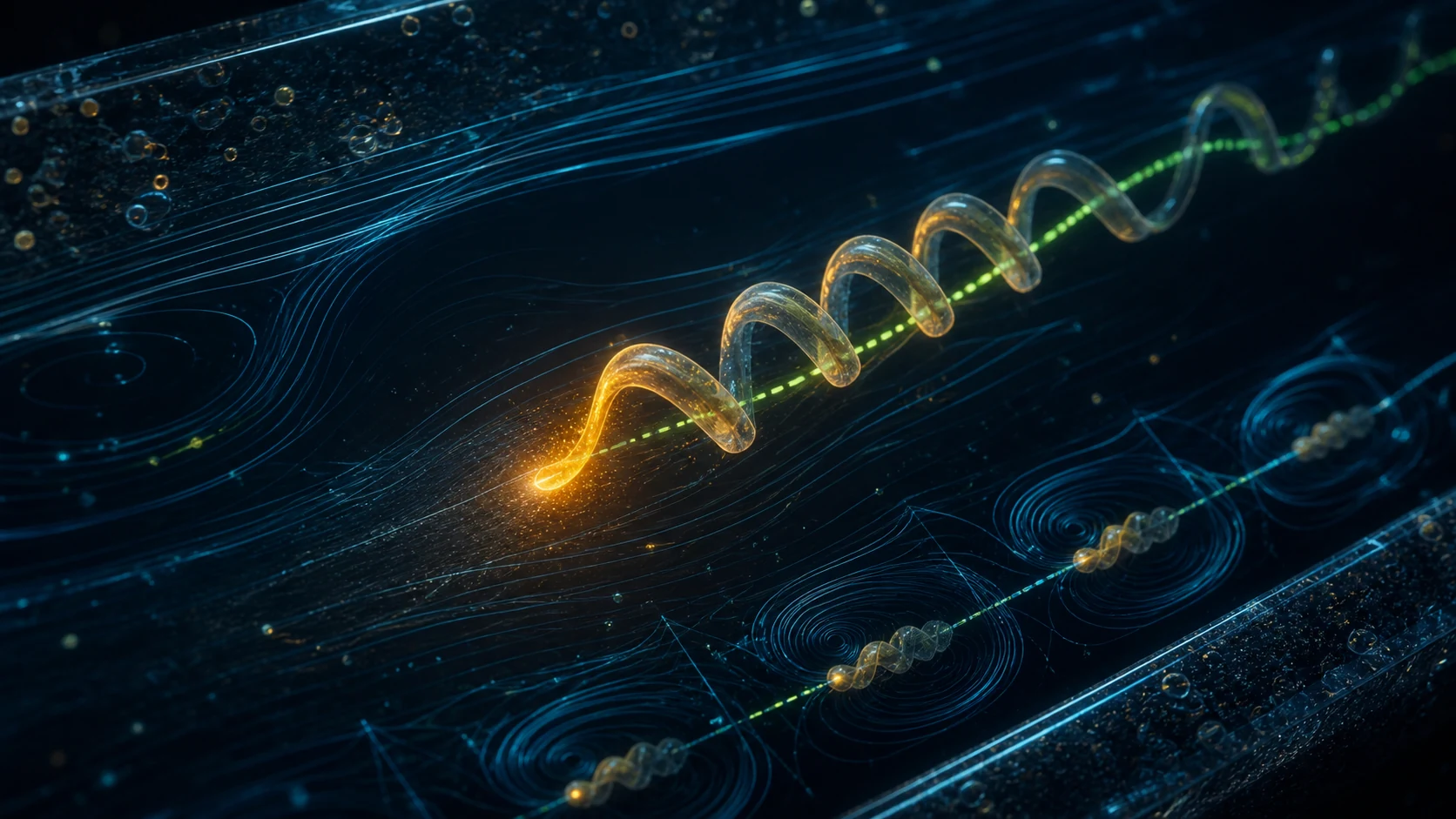
At small scales, a reversible stroke tends to reverse its own progress; propulsion must exploit a different cycle.
Control Becomes a Systems Problem
A tiny machine in fluid must contend with viscosity, Brownian disturbances, nearby surfaces, geometry, and the way it receives energy or control. Locomotion cannot be separated cleanly from sensing, power, fabrication, material compatibility, and the surrounding medium.
That interdependence is exactly where systems thinking becomes useful. The right unit of design is not the animated device alone; it is the device, environment, actuation method, measurement apparatus, control model, and intended task.
Where Software Still Belongs
Software can simulate candidate geometries, coordinate external fields, reconstruct motion from microscopy, estimate parameters, and compare observed trajectories with a physical model. It can search a design space far faster than a person can sketch it. It can also produce beautifully precise nonsense when the model, boundary conditions, or measurements are wrong.
The standard must therefore be a closed evidence loop: model, predict, fabricate or obtain a specimen, measure, compare, revise. Software adds leverage to each stage; physical validation decides whether the leverage points in the right direction.

Control becomes credible only when actuation, observation, geometry, and the surrounding fluid remain connected.
What I Am Learning To Notice
The valuable habit is to identify the dimensionless relationships before trusting an intuitive picture. What forces are being compared? What characteristic length is relevant? Is the surrounding fluid bounded by a nearby wall? Does the actuation cycle actually break time symmetry? Can the motion be measured without the observation method becoming a major part of the experiment?
Those questions are more useful than pretending to have a finished nanomachine design. They turn fascination into a sequence of falsifiable engineering decisions.
Context And Limits
This essay translates a working knowledge base into public understanding. It separates established principles from personal interpretation; it should mature as deeper study, better sources, simulation, measurement, and laboratory experience add pressure to the model.
The standard is simple: confidence should never outrun evidence.