Nanoscale Learning Note 003
Transport, Randomness, And Control
Diffusion and Brownian motion show why randomness is not an inconvenience at small scales; it is part of the design environment.
Randomness Becomes Visible
At everyday scale, the thermal motion of surrounding molecules disappears into an average. At microscopic and nanoscale dimensions, that motion can jostle particles into irregular paths that are visible and consequential. Brownian motion is not a defect in the universe; it is the statistical texture of the environment.
This changes the meaning of control. A useful system may not eliminate randomness. It may bias a probability distribution, create a restoring force, shape a channel, use binding affinity, or gather enough observations to distinguish directed behavior from fluctuation.
Diffusion Rewards Short Distances
Diffusion spreads particles from regions of higher concentration toward lower concentration through random molecular motion. A crucial scaling idea is that characteristic diffusion time grows roughly with the square of distance. Cut the distance and transport can become dramatically faster; increase it and passive transport becomes rapidly less convenient.
This is one reason microfluidic geometries can be so powerful. Small channels shorten transport distances and create large interface relative to volume. A design can use that geometry to mix, separate, sense, or react without relying on the same turbulence that makes a kitchen blender intuitive.
At small scales, probability is not the absence of engineering; it is one of the materials engineering must shape.
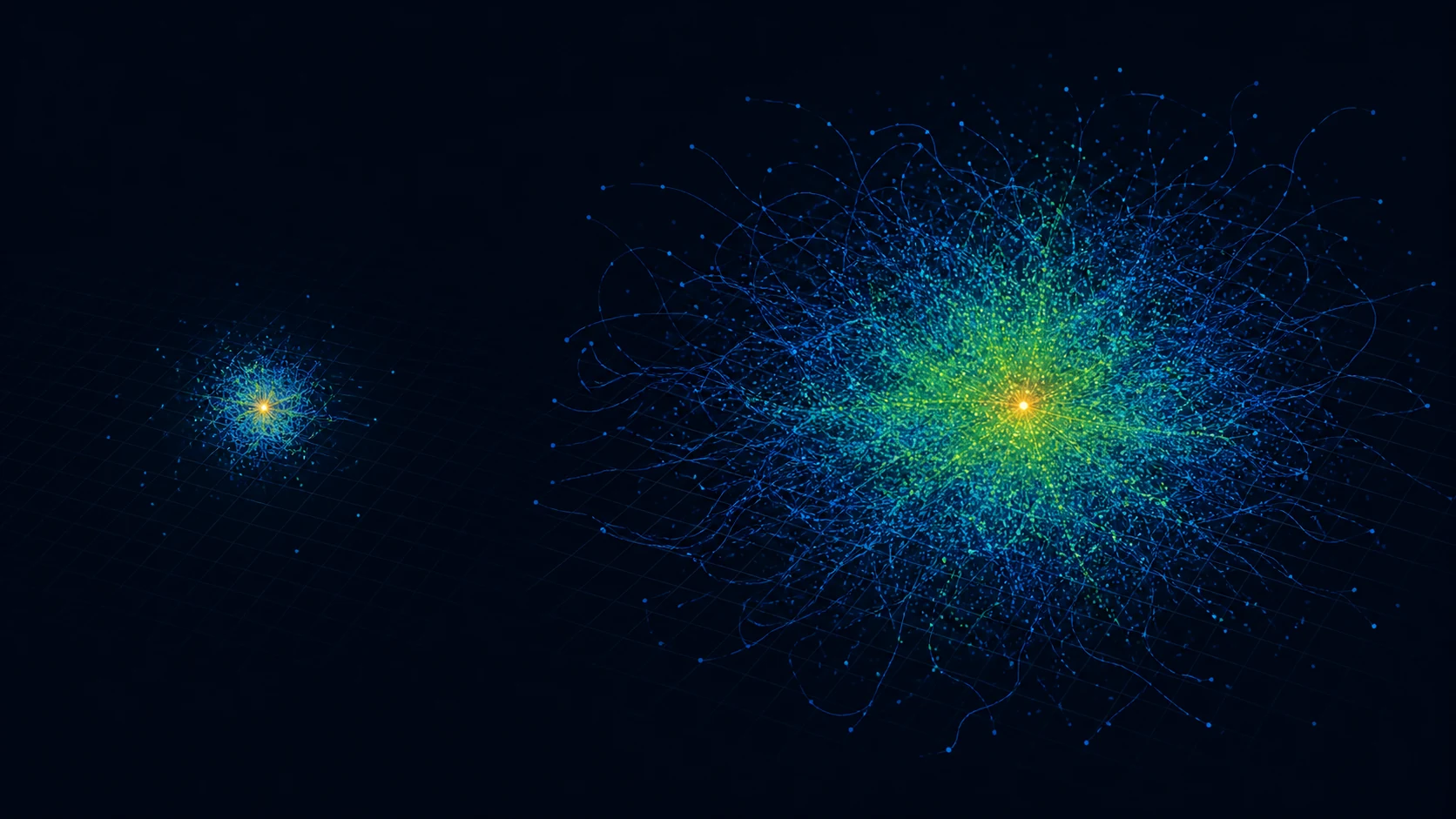
A small increase in transport distance can demand much more time; geometry therefore becomes an active design decision.
Signal Must Be Separated From Motion
Suppose a particle appears to move toward a target. Did a field direct it? Did a fluid drift carry it? Did it bind selectively? Or did a random path happen to look purposeful during a short observation window? The more captivating the demonstration, the more important these alternative explanations become.
Repeated trials, controls, trajectory statistics, calibrated imaging, and clear uncertainty are therefore central to credibility. One dramatic path is a story; a distribution collected under controlled conditions can become evidence.
Software As The Statistical Lens
This is an especially natural bridge from software into physical science. Image processing can locate particles across frames. Tracking software can reconstruct trajectories. Statistical models can estimate diffusion coefficients, compare populations, and expose drift. Reproducible data pipelines can preserve the connection between raw observation and published figure.
My responsibility is to resist turning technical fluency into scientific overconfidence. A clean pipeline does not rescue a biased experiment; a sophisticated model does not compensate for an uncalibrated instrument. The entire chain has to remain inspectable.

Repeated observations reveal the stable pattern, the uncertainty, and the outliers that a single demonstration can hide.
A Better Mental Model for Tiny Systems
A nanoscale device should not always be imagined as a miniature robot following deterministic commands. It may be better understood as a structure that changes rates, affinities, barriers, fields, or local probabilities. The intelligence can live partly in geometry and materials; external software may observe and coordinate the larger system.
That model feels less like science fiction and more like engineering. It also opens more honest questions about what must be fabricated, measured, powered, controlled, and verified before a fascinating behavior becomes a useful capability.
Context And Limits
This essay translates a working knowledge base into public understanding. It separates established principles from personal interpretation; it should mature as deeper study, better sources, simulation, measurement, and laboratory experience add pressure to the model.
The standard is simple: confidence should never outrun evidence.