AI assurance architecture
Why RAG Fails at Every Scale: Retrieval Is Not Assurance
RAG can find relevant text; it cannot decide what an organization is authorized to trust, do, or accept. A rigorous case for moving from retrieval toward GRAZE.
Retrieval-augmented generation can find relevant text. It cannot decide what an organization is authorized to trust, what a model is permitted to do, or when a result is safe to accept.
That distinction is the reason many RAG demonstrations feel convincing while production systems remain brittle. The answer contains familiar language. A citation appears beside it. The model sounds informed. Yet the system may still have retrieved the wrong policy version, flattened a disagreement, crossed a permission boundary, followed an instruction hidden inside a document, or produced a claim the source never supported.
RAG is not useless. It is incomplete. It solves an important access problem; it is frequently promoted into an assurance role it was never designed to hold.
Similarity is not authority. A citation is not verification. Retrieval is not acceptance.
RAG Solved a Real Problem
The original 2020 RAG paper joined a generative model with an external dense index for knowledge-intensive language tasks. The architecture gave a model access to information beyond its parameters and offered a path toward provenance and fresher knowledge.1 NIST's current definition preserves that essential shape: retrieve relevant information from a knowledge base; provide it to the model as context.2
That remains useful. In a bounded structured-output workflow, peer-reviewed industry research found that RAG significantly reduced hallucination and enabled a smaller model.11The honest conclusion is not that retrieval never works. It is that retrieval should be judged against the problem it actually solves.
The old problem was primarily access: the answer may exist outside the model. Today's consequential problem is acceptance: even when relevant text is available, should this source control this decision, for this user, under these conditions, at this moment?

RAG improves access to external information. Consequential work continues through authority, permission, contradiction, verification, and acceptance decisions that similarity alone cannot settle.
Small RAG Fails Quietly
A small knowledge base looks safe because it looks knowable. In practice, a handful of documents can hide a disproportionate amount of ambiguity. The newest procedure may conflict with the signed contract. The owner may keep a crucial exception in memory. A customer promise may live in email. A copied template may look official after its authority expired.
When the corpus is thin, every bad chunk carries more weight. Retrieval may be technically accurate and still be operationally wrong. It found the nearest sentence; it did not discover that the sentence was superseded, contested, confidential, or inapplicable to this customer.
The Most Important Rule May Not Be Written
Small organizations often rely on judgment, relationships, and exceptions that no index can retrieve.
A Familiar Document Can Still Be Wrong
Recency, ownership, approval, and scope matter more than semantic resemblance.
Low Volume Can Hide Failure
A persuasive answer may survive for weeks before the rare exception reveals the missing boundary.
One Error Can Be the Whole Quarter
Small scale reduces sample size; it does not necessarily reduce the cost of a bad commitment.

Sparse records, tacit knowledge, and high-consequence exceptions make confident retrieval especially dangerous when the business has little room for rework.
Large RAG Fails Loudly
Enterprise scale adds documents faster than it adds truth. The index inherits duplicated policies, department-specific language, conflicting jurisdictions, inherited permissions, abandoned experiments, and years of local workarounds. More retrieval can increase coverage while also increasing the surface area for contradiction and attack.
Global questions expose the limit. Conventional RAG is good at locating passages that resemble a query; it struggles when the task requires understanding themes across an entire corpus. Microsoft Research identified this local-to-global gap and developed GraphRAG for corpus-wide sensemaking.7That work improves a retrieval and synthesis problem. It still does not decide which executive owns the consequence or whether a synthesized conclusion satisfies policy.
Long context does not erase the issue. Research has shown that models can use relevant information unevenly depending on where it appears within the context.3 Security adds another boundary. PoisonedRAG demonstrates knowledge-base corruption attacks in experimental settings; NIST warns that retrieved content can blur data and instruction channels through indirect prompt injection.910

Scale multiplies sources, versions, owners, permissions, terminology, and adversarial surface. Relevance cannot resolve those obligations by itself.
The Failure Is Larger Than Retrieval
RAG is commonly evaluated as though one score could explain the system. Better evaluation research separates context relevance, answer faithfulness, and answer relevance.5RAGChecker goes further by diagnosing retrieval and generation behavior separately.6 Those distinctions are valuable; consequential operations need an even wider failure model.
- Retrieval failure: the necessary evidence was missed, poorly ranked, or never indexed.
- Assembly failure: useful fragments were truncated, duplicated, or positioned where the model used them poorly.
- Interpretation failure: the model misunderstood, merged, or overstated what the evidence said.
- Provenance failure: the answer cannot defend which source supports which claim.
- Authority failure: a relevant source lacked the right to govern this decision.
- Security failure: retrieved content carried malicious instructions or crossed an access boundary.
- Acceptance failure: no accountable Human or policy owner accepted the consequence.
RAGTruth's annotated corpus confirms that unsupported and contradictory claims can survive inside retrieval-grounded responses.4 Self-RAG adds learned retrieval decisions and self-reflection, another sign that raw retrieve-and-generate behavior benefits from explicit critique.8 Yet critique by the same system is still not independent authority. A model can review a proposal; it cannot appoint itself owner of the outcome.
From RAG to GRAZE
At VerShep, I use a public design doctrine I call GRAZE: Governed Retrieval, Authority & Zoned Evidence. The name is intentionally related to RAG because retrieval remains useful. The difference is where the center of gravity lives.
RAG asks what information resembles the query. GRAZE asks what evidence is eligible to influence an outcome, which authority controls each boundary, and what must happen before a responsible Human can accept the work.
Govern the Outcome
Define the decision, consequence, owner, and stop condition before retrieval begins.
Retrieve as a Capability
Use retrieval where it helps; never confuse nearest context with accepted truth.
Make Authority Explicit
Preserve who may approve, supersede, disclose, or act on each class of evidence.
Zone the Evidence
Keep raw intake, working context, contested material, accepted truth, and approved memory distinct.
Earn Acceptance
Treat generation as a proposal; verify claims and return consequence to its accountable Human owner.
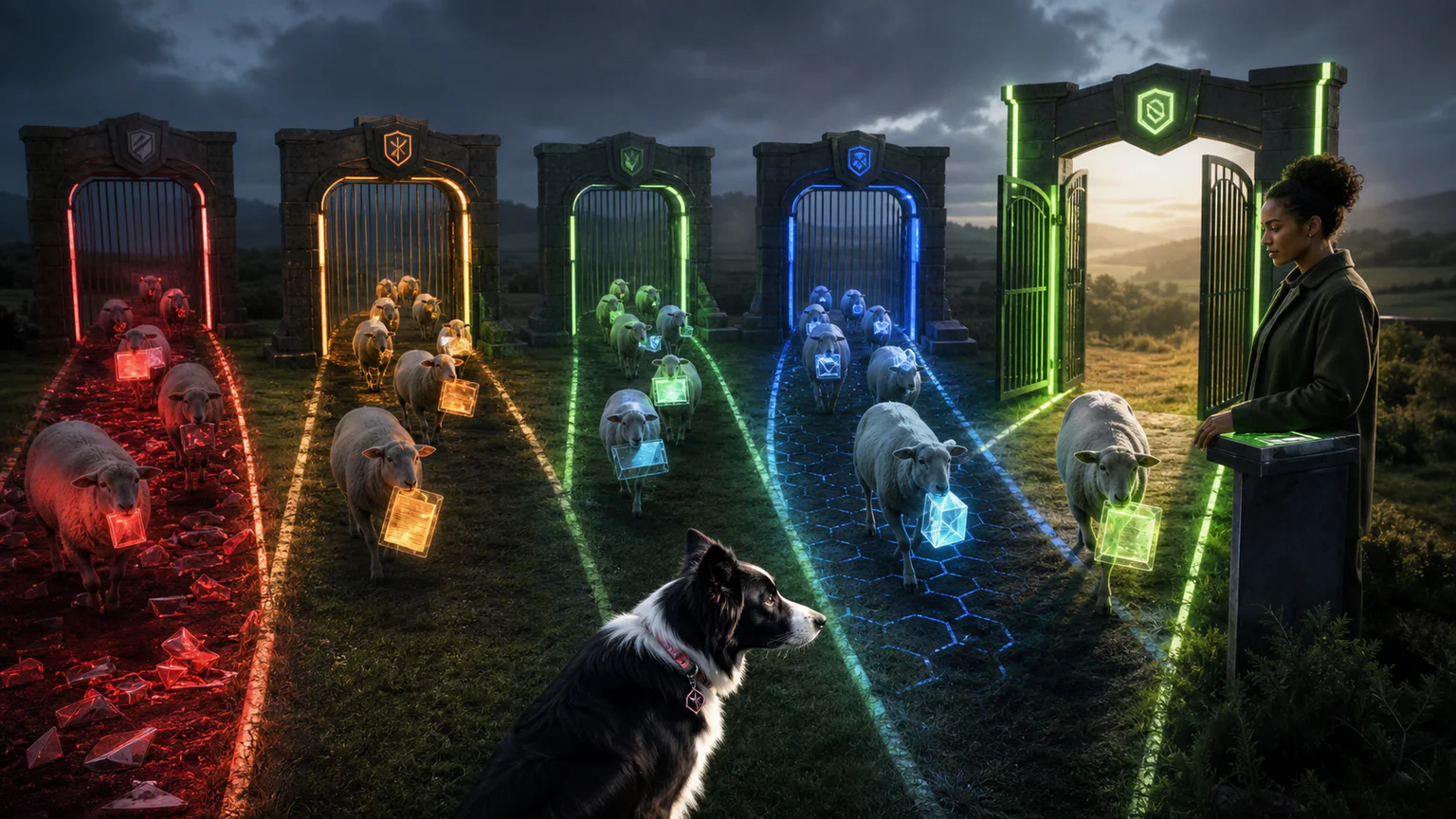
Retrieval remains one capable member of the system. Governed zones preserve source status, authority, contradiction, and Human ownership as the work moves.
What GRAZE Does Not Disclose
GRAZE is presented here as a public doctrine, not an implementation specification. This essay does not disclose VerShep's private schemas, compression methods, indexing strategies, routing logic, scoring, thresholds, correction storage, memory promotion, orchestration, or verification mechanisms. Those details may include trade secrets and potential patent subject matter.
The public claim is deliberately narrower: consequential AI needs an assurance architecture around retrieval. CPF provides my opinionated architecture for those responsibilities; GRAZE gives the retrieval portion a memorable public language. Neither label is presented as an independent benchmark result or a guarantee.

A responsible path preserves the distinction between finding information, proposing work, verifying evidence, and accepting consequence.
Where RAG Still Belongs
RAG remains an excellent fit when the task is bounded, the corpus is curated, authority is simple, the cost of error is low, and the user can inspect the answer. Documentation search, source discovery, draft support, internal navigation, and constrained structured extraction can all benefit.
RAG is not enough when the work changes money, access, employment, safety, public commitments, regulated claims, customer rights, or production systems. In those environments, the organization needs more than a better answer. It needs a defensible path from evidence to consequence.
The Durable Advantage Lives After Retrieval
Models will gain larger contexts. Retrieval will become more adaptive. Graphs, agents, rerankers, and multimodal indexes will improve. None of those advances removes the need to decide what the organization trusts, who has authority, which contradictions must survive, how evidence is verified, and who accepts the result.
The competitive advantage is not a larger pile of retrieved text. It is the ability to convert changing information into governed organizational judgment without losing source, responsibility, or the right to say no.
Continue from the retrieval argument into the public architecture, the company building it, or one bounded workflow.
Research Record
References and Evidence
Sources were reviewed on August 29, 2026. This essay distinguishes peer-reviewed findings, government definitions and guidance, security demonstrations, and my architectural interpretation. Research is scoped to the task and system studied; no cited paper establishes a universal RAG failure rate or validates GRAZE, CPF, or VerShep. The public doctrine describes responsibilities while deliberately withholding private implementation detail.
- Retrieval-Augmented Generation for Knowledge-Intensive NLP TasksPeer-Reviewed Research · Advances in Neural Information Processing Systems 33; 2020
The original RAG paper joins a parametric sequence-to-sequence model with a non-parametric Wikipedia index for knowledge-intensive NLP tasks. It motivates retrieval through provenance, factual knowledge, and update limitations in parametric models; it does not propose a complete production assurance architecture.
- Retrieval Augmented GenerationGovernment Definition · National Institute of Standards and Technology Computer Security Resource Center
NIST defines RAG as pairing a generative model with a retrieval mechanism and knowledge base so retrieved information can be supplied as context. The definition establishes the technique's scope; it does not assign authority, verification, or acceptance responsibilities.
- Lost in the Middle: How Language Models Use Long ContextsPeer-Reviewed Research · Transactions of the Association for Computational Linguistics; 2024
Across multi-document question answering and key-value retrieval, performance was often strongest when relevant information appeared near the beginning or end of context and degraded when it appeared in the middle. The study does not test every current model, task, or deployment.
- RAGTruth: A Hallucination Corpus for Developing Trustworthy Retrieval-Augmented Language ModelsPeer-Reviewed Benchmark · Proceedings of the 62nd Annual Meeting of the Association for Computational Linguistics; 2024
RAGTruth contains nearly 18,000 naturally generated responses with annotations for unsupported and contradictory claims. It demonstrates that retrieved context does not eliminate hallucination; it is a benchmark, not a universal production failure rate.
- ARES: An Automated Evaluation Framework for Retrieval-Augmented Generation SystemsPeer-Reviewed Evaluation Research · Proceedings of NAACL-HLT; 2024
ARES separates context relevance, answer faithfulness, and answer relevance, supported by a small Human-annotated validation set. The separation supports diagnostic evaluation; it does not prove that every RAG system fails.
- RAGChecker: A Fine-grained Framework for Diagnosing Retrieval-Augmented GenerationPeer-Reviewed Evaluation Research · NeurIPS Datasets and Benchmarks Track; 2024
RAGChecker introduces retrieval and generation diagnostics and evaluates eight RAG systems. Its findings show interacting design tradeoffs across the pipeline; they should not be generalized into a single failure rate for all systems.
- From Local to Global: A Graph RAG Approach to Query-Focused SummarizationPeer-Reviewed Research · Microsoft Research; 2024
The paper identifies global corpus questions as a weakness for conventional RAG and reports improved comprehensiveness and diversity from a graph-based approach on million-token datasets. It addresses a specific sensemaking problem rather than proving that all RAG is ineffective.
- Self-RAG: Learning to Retrieve, Generate, and Critique through Self-ReflectionPeer-Reviewed Research · International Conference on Learning Representations; 2024
Self-RAG learns when to retrieve and uses reflection tokens to critique relevance, support, and usefulness. It is evidence that retrieval benefits from additional control and evaluation; it does not validate GRAZE or disclose VerShep's implementation.
- PoisonedRAG: Knowledge Corruption Attacks to Retrieval-Augmented Generation of Large Language ModelsPeer-Reviewed Security Research · 34th USENIX Security Symposium; 2025
The paper demonstrates knowledge-base poisoning attacks in constructed experimental settings and identifies the retrieval database as an attack surface. Its reported success rates belong to those experiments; they are not universal incident rates.
- Adversarial Machine Learning: A Taxonomy and Terminology of Attacks and MitigationsGovernment Security Guidance · NIST AI 100-2e2025; March 2025
NIST explains that RAG can blur data and instruction channels, allowing indirect prompt injection through external context and creating downstream availability, integrity, or privacy consequences. The document is a taxonomy and guidance resource, not an evaluation of CPF or VerShep.
- Reducing Hallucination in Structured Outputs via Retrieval-Augmented GenerationPeer-Reviewed Industry Research · NAACL Industry Track; 2024
In one bounded enterprise structured-output setting, RAG significantly reduced hallucination and enabled use of a smaller model. This is useful counterevidence: RAG can solve a defined retrieval-grounding problem, but reduction is not elimination and one workflow does not establish complete operational assurance.