National Football League VR Training
An immersive training experience that used virtual reality to make complex, repeatable football scenarios available beyond the physical field.
The role statement defines my contribution boundary for this record. Client leaders, product partners, designers, artists, quality specialists, operators, and other engineers retain credit for their respective work; a project is described as independently built only when the supplied operating record supports that claim.
The Mandate
Create More Repetitions Of The Decisions That Matter.
Professional football creates an unusual training constraint; the most valuable reads happen quickly, depend on spatial relationships, and cannot always be repeated physically at full speed. VR offered a way to rehearse recognition and response, but only if the simulation protected orientation, comfort, timing, and coaching intent.
The Product As a Complete System
The visible experience was only one layer. These were the responsibilities that had to cooperate for the product to remain useful under real operating pressure.
Scenario Model
Formation, player relationships, timing, viewpoint, and the specific read a repetition is intended to train.
A scenario needed enough structure to be repeatable without pretending every real play is deterministic.
Perceptual Runtime
Spatial scale, motion, audio, visual cues, and the athlete's stable sense of position.
Immersion could not come at the cost of orientation or comfort.
Interaction & Response
The moment of recognition, the available response, and feedback that connects action to the training objective.
The interface had to stay out of the way while making the relevant decision observable.
Coaching Loop
Scenario selection, repetition, review, progression, and the conversation surrounding performance.
VR needed to extend coaching judgment, not replace it with a headset and an opaque score.
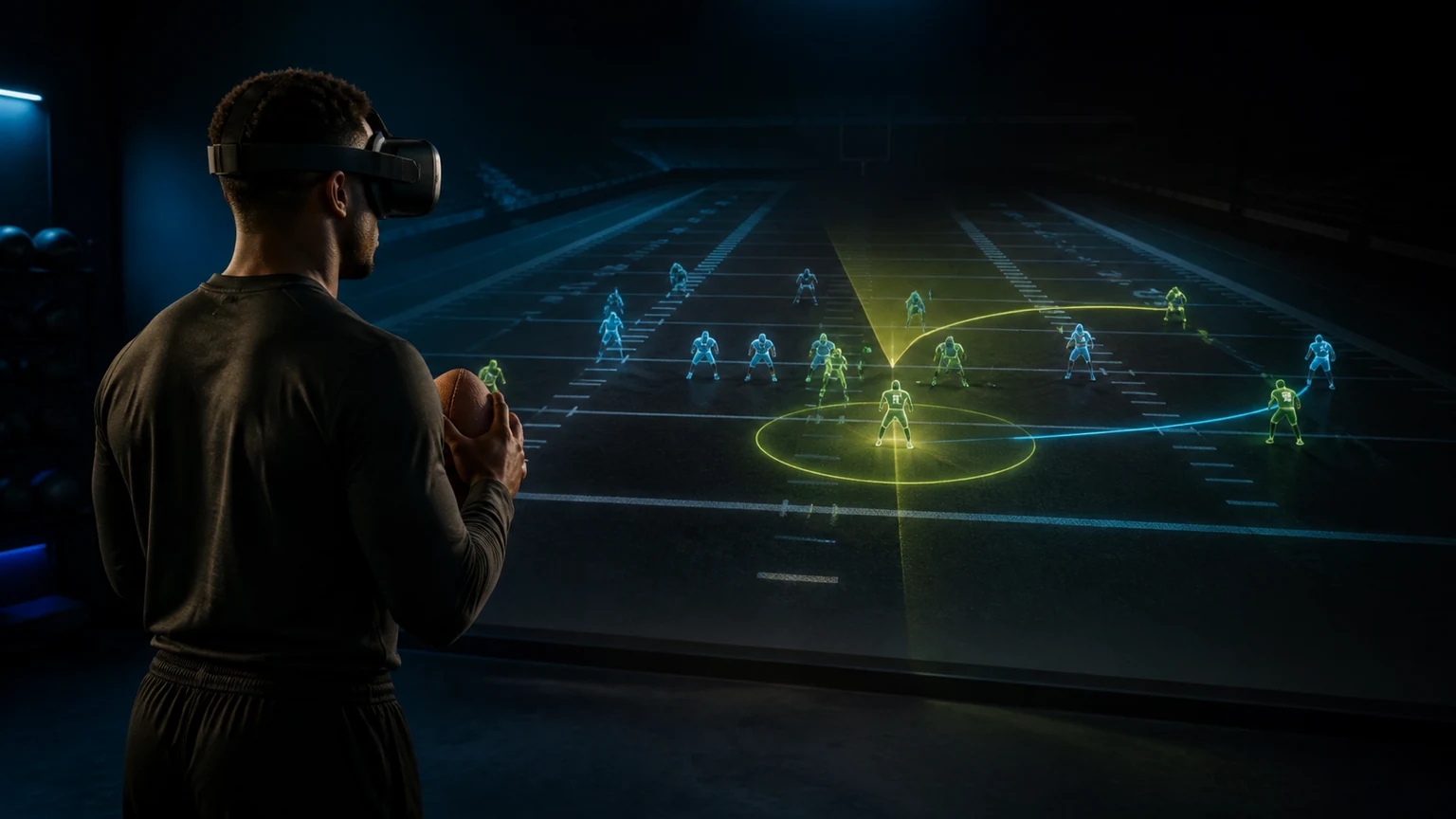
A focused spatial rehearsal preserves the cues that affect an athlete's read without confusing visual excess with useful fidelity.
What The System Had To Solve
- Represent fast, spatially complex play conditions inside a headset without losing orientation.
- Make repetition useful for learning rather than simply recreating spectacle.
- Balance visual fidelity, responsiveness, comfort, and training intent.
- Create enough perceptual fidelity for decision rehearsal while protecting frame rate, comfort, and coaching clarity.
How I Approached It
- Organized the experience around readable spatial cues and repeatable scenarios.
- Treated performance and comfort as product requirements, not final-stage polish.
- Used real-time simulation to create practice opportunities that physical logistics alone could not provide.
- Separated the training objective from decorative realism so each scenario could focus attention on the recognition and response being practiced.
The Tradeoffs That Shaped The Product
Architecture becomes meaningful when the decision, alternative cost, and operating reason remain visible together.
Behavioral Fidelity First
Prioritize the spatial relationships and timing needed for the training decision over decorative detail.A simulation can look realistic while teaching the wrong attention pattern. Fidelity had to serve perception and response.
Comfort Is Functional
Treat frame rate, camera behavior, orientation, and session design as core training requirements.A physically uncomfortable system shortens useful practice and adds cognitive noise unrelated to the skill being trained.
Coach In The Loop
Frame VR as a repeatable scenario and review tool inside a broader coaching process.The product becomes more credible when technology creates better evidence for a human expert instead of claiming to replace expertise.
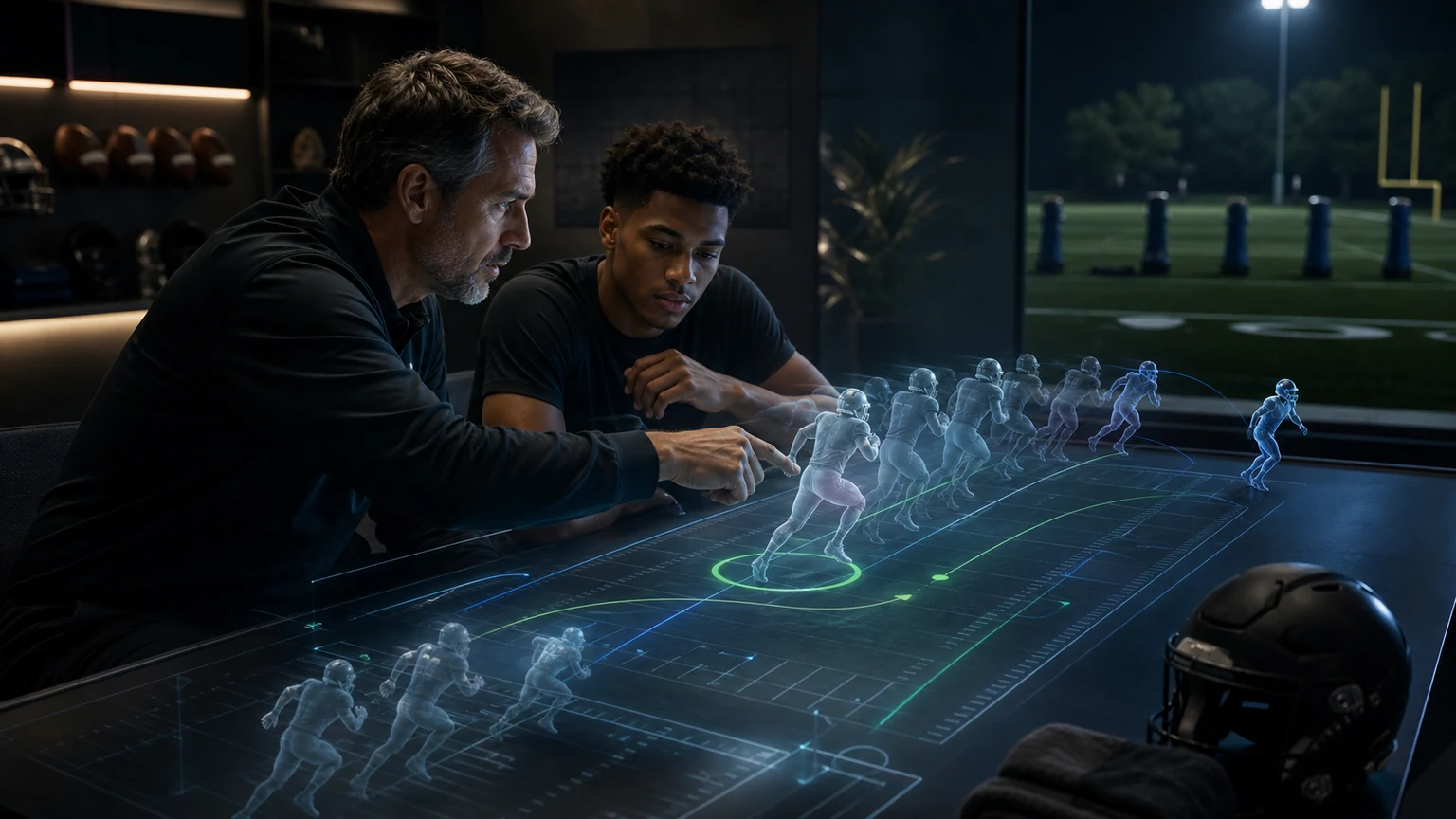
Coach and athlete can review the same sequence together; the conversation becomes more specific than memory alone.
What Changed
- The project demonstrated virtual reality as a practical medium for professional sports training.
- Repeatable scenarios created a bridge between tactical understanding and embodied decision-making.
- The work expanded a portfolio already grounded in real-time systems and immersive learning.
- The case established a reusable decision framework for simulation work; fidelity should be measured against the behavior being trained.
What Supports The Story
Evidence is classified so a reader can distinguish public verification, portfolio-reported outcomes, and implementation details shared from direct experience.
Project Identity
The portfolio record identifies the engagement as National Football League VR Training.
Engineering Domain
The work sits at the intersection of real-time 3D, virtual reality, simulation, and performance training.
Design Standard
The case-study reasoning distinguishes behavioral fidelity from decorative realism.
Disclosure
No unsupported adoption, performance, or athlete-outcome metrics are claimed on this page.
This case study shares the system-design reasoning that can be discussed responsibly. Team-specific scenarios, athlete data, play information, partner materials, quantitative performance results, and confidential implementation details are intentionally omitted.
What The Project Taught Me
Prioritize the training decision a player must recognize over decorative realism.
A simulation earns value when repetition improves perception, judgment, or action.
Useful for sports, industrial rehearsal, safety training, and any domain where practice space is scarce or expensive.
What This Work Demonstrates
- Virtual reality
- Simulation
- Real-time 3D
- Performance training