Army National Guard Disasterville
An immersive natural-disaster experience that brought emergency scenarios into American high school gyms; technology, space, and story worked together to make preparedness tangible.
The role statement defines my contribution boundary for this record. Client leaders, product partners, designers, artists, quality specialists, operators, and other engineers retain credit for their respective work; a project is described as independently built only when the supplied operating record supports that claim.
What The System Had To Solve
- Translate large-scale natural-disaster scenarios into an experience appropriate for a school environment.
- Coordinate software, physical space, media, and live operations as one coherent visitor journey.
- Balance spectacle with clarity so the technology served the message instead of overpowering it.
How I Approached It
- Designed around the complete audience journey; entry, orientation, interaction, and reflection mattered as much as any single effect.
- Treated the gym as an adaptable runtime environment with real operational constraints.
- Used immersive media to make abstract risk easier to understand without turning preparedness into entertainment alone.
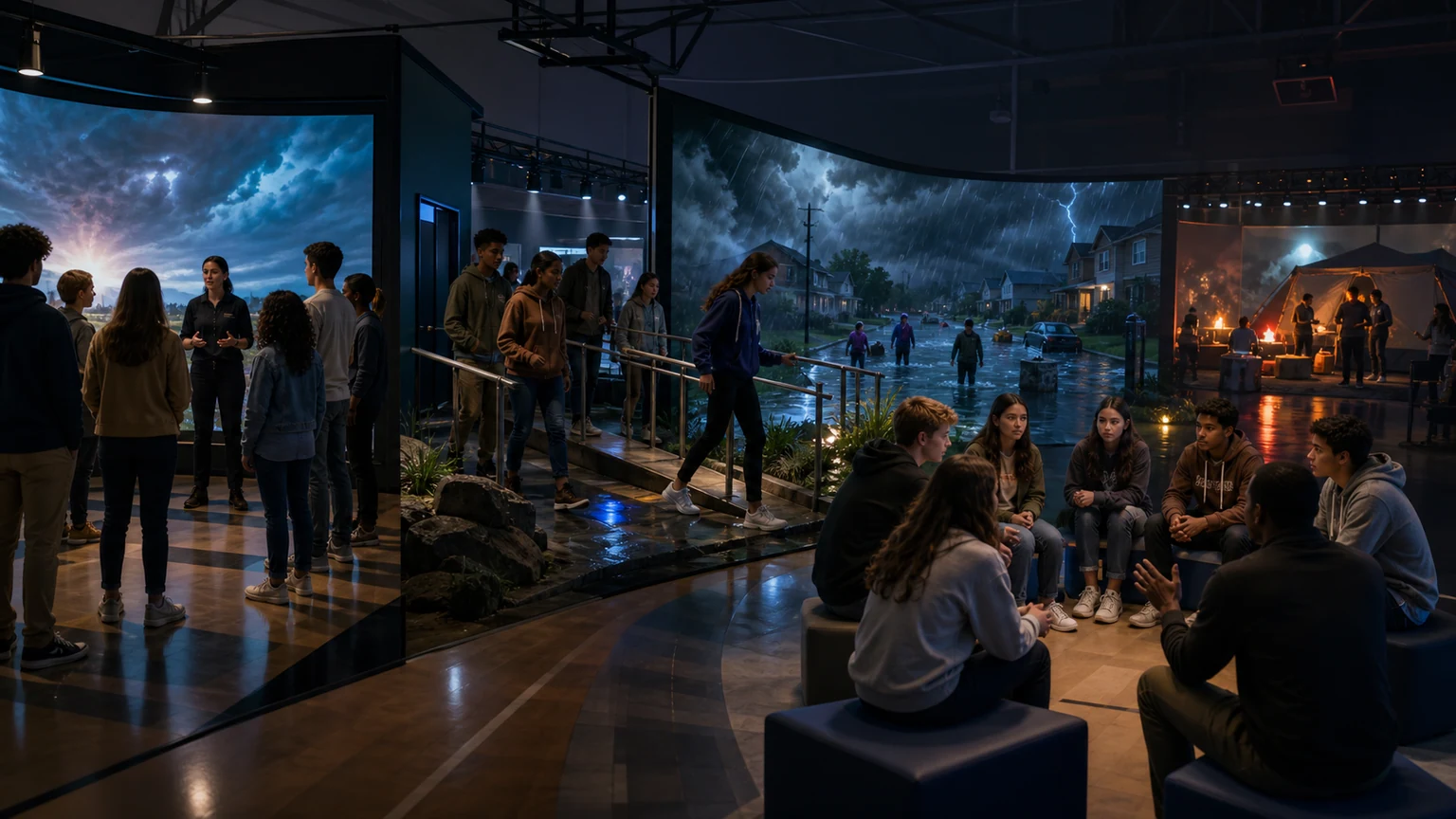
Students move from an immersive preparedness scenario into reflection; the emotional moment remains connected to what they should learn and remember.
What Changed
- The campaign brought natural-disaster scenarios directly into United States high school gyms.
- The work demonstrated how interactive technology can support public communication and experiential learning.
- A public campaign record is available through Little Black Book.
Outcome language is drawn from my project record. Where a number is not independently published, the wording identifies it as a portfolio-reported result.
What The Project Taught Me
Let the physical environment carry part of the interface so the experience felt immediate without becoming confusing.
Immersion is most useful when it gives consequence a shape people can understand.
Useful for public education, experiential campaigns, simulation, museums, and location-based technology.
What This Work Demonstrates
- Immersive media
- Interactive systems
- Spatial experience
- Live installation